
In June 2022, the European Commission adopted temporary trade liberalisation measures between the European Union and Ukraine, including the suspension of tariff quotas for medium- and low-quality common wheat, maize, and barley originating in Ukraine. These measures have been extended until 5 June 2025 by Regulation (EU) 2024/1392.
Following the conclusion of this temporary period, the Official Journal of the European Union (OJEU) has published Commission Implementing Regulation (EU) 2025/1132 of 3 June 2025, which amends Implementing Regulations (EU) 2020/761 and 2020/1988 with regard to the 2025 tariff quotas for Ukrainian-origin products. According to this regulation, between 6 June and 31 December 2025:
- The annual quota amounts are prorated for the remainder of the year, and their order numbers are updated accordingly.
- Quotas will be allocated in chronological order based on the acceptance date of customs declarations for release into free circulation.
- The preferential origin of goods must be proven by submitting a EUR.1 movement certificate or an invoice declaration, and the direct transport rule must be met.
- An AGRIM certificate is not required to benefit from the quota.
- The import duty under the quota will be €0.
The quantities and order numbers are as follows:
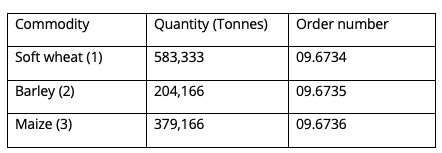
- Includes CN Codes 1001 99 (00), 1101 00 (15-90), 1102 90 (90), 1103 11 (90), 1103 20 (60)
- Includes CN Codes NC 1003 90 (00), 1102 90 (10), ex 1103 20 (25)
- Includes CN Codes 1005 90 (00), 1102 20 (10-90), 1103 13 (10-90), 1103 20 (40), 1104 23 (40-98)
When managing quotas based on the chronological order of customs declaration acceptance dates for release into free circulation, please take the following into account:
- The theoretical availability of each quota can be consulted via the following link: Consultation of tariff quotas
- Quota allocations are carried out by the Commission based on all customs declarations accepted daily throughout the EU. Allocations are not processed until the second working day after the acceptance date of the relevant declaration. It is therefore common for requests to be pending when viewing the current quota balance or submitting a release declaration. As a result, the displayed quota balance does not account for pending applications.
- If a release is requested at the time of submitting a declaration and the quota is allocated for a quantity less than declared, import duties will be assessed on the portion not covered by the quota. To avoid this, it is possible to submit the declaration and make the release conditional on the quantity assigned under the quota. This may cause a short delay in the release, with the unallocated portion remaining pending.
- In certain cases, the Commission may designate a quota as critical. In such instances, release is subject to a guarantee equal to the amount of import duties due, until the quota is allocated.
- Goods should be unloaded at authorised facilities (e.g. temporary storage or customs warehouses) to ensure sufficient time to proceed with release in the event of quota shortages.
Should you require any further information or assistance, our customs department remains at your disposal.